
Nobody warns you that your relationship with sleep changes. When you’re young, you can burn the candle at both ends, Netflix until 2am, sleep in on Sundays until noon, and bounce back like it never happened. Then one day — somewhere in your fifties — sleep becomes something you have to earn.
I used to sleep beautifully. Deeply. Reliably. The kind of sleep where your head hits the pillow and the next thing you know it’s morning. Back then I also had a pet theory: that I could stockpile sleep like a camel stores water in its hump — skip a few nights, bank the deficit, then retrieve it all on a long weekend lie-in. I even used to joke about it with friends.
Well. As it turns out, sleep doesn’t work like a camel. You can’t store it, you can’t retrieve it on demand, and the debt doesn’t just quietly dissolve. Science has been pretty unambiguous on this for a while — I was just too well-rested (and too smug) to pay attention. This is the story of how I woke up to reality, and how I earned my sleep back.
First, a quick primer on what we’re actually chasing
Sleep isn’t just unconsciousness. It’s a highly structured biological process that cycles through stages roughly every 90 minutes. Within those cycles, two phases matter most for quality rest:
Deep Sleep (Stage 3 NREM)
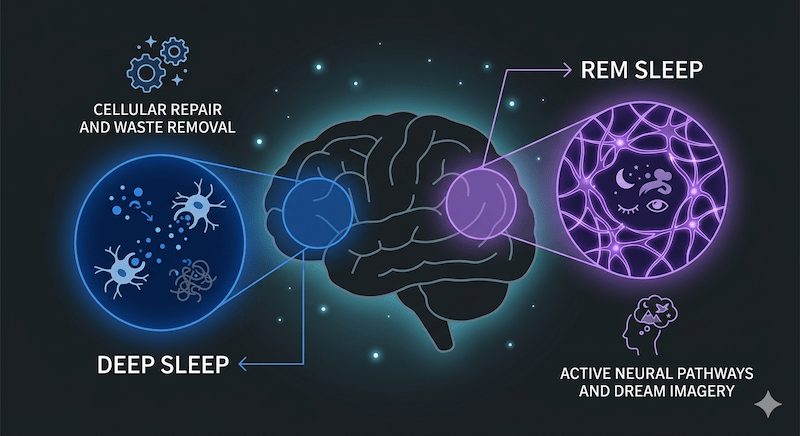
Think of this as your body’s repair and maintenance mode. Your heart rate slows, your muscles relax, and — crucially — your brain activates the glymphatic system, which essentially flushes out metabolic waste products (including amyloid plaques linked to Alzheimer’s disease). Growth hormone is released in significant quantities here. Memory consolidation happens. Miss enough deep sleep and you wake up feeling like the sleep never happened — because, in a meaningful biological sense, it didn’t.
REM Sleep (Rapid Eye Movement)
This is dream sleep — and it’s far more important than its whimsical reputation suggests. During REM, your brain is almost as active as when you’re awake, processing emotions, consolidating learning, and essentially “defragging” the day’s experiences. Your body is temporarily paralysed (a protective mechanism so you don’t act out your dreams). Creativity, emotional regulation and resilience all depend heavily on adequate REM sleep. Chronically short on REM and you’ll notice it in your mood, patience and mental sharpness long before you see it in a wearable’s data.
What does “good quality sleep” actually look like?
- Total sleep: 7–9 hours for most adults (this doesn’t change much with age, though the architecture shifts)
- Deep sleep: Roughly 13–23% of total sleep, equating to about 1–2 hours
- REM sleep: Roughly 20–25% of total sleep, equating to about 1.5–2 hours
- Sleep efficiency: The percentage of time in bed actually spent asleep — above 85% is considered healthy
Deep sleep is front-loaded (you get most of it in the first half of the night) while REM is back-loaded (you get more of it in the second half). This is one reason why cutting your sleep short by even an hour preferentially steals REM — you’re truncating the most REM-rich portion of your cycle.

The camel theory — and why it’s completely wrong
So about that camel joke. I genuinely believed it for years. Miss some sleep during the week, sleep in on weekends, all balanced out. It felt intuitive. It was completely false.
What research shows is that while you can partially recover some aspects of sleep deprivation (like subjective alertness), the neurological and metabolic damage accumulates and doesn’t fully reverse with catch-up sleep. Chronic sleep debt is not a bank account — it’s more like compound interest working against you. Each night of poor sleep adds to a biological cost that sleep-ins can only partially offset.
And the weekend lie-in habit carries its own problem: social jetlag. Sleeping until 11am on Saturday and Sunday essentially gives you the circadian equivalent of flying to a different time zone twice a week. Your body clock gets confused, which makes Monday mornings brutal and — ironically — makes the next week’s sleep worse. I kept this habit going for years after I’d stopped working regular hours, more out of nostalgia than need. Dropping it was one of the highest-impact changes I made.
What happens when you consistently skimp on quality sleep?
I used to think “I’ll sleep when I’m dead.” Turns out, chronic poor sleep accelerates the timeline to exactly that. The effects are far-reaching and they compound over time:
- Cognitive decline accelerates — processing speed, memory retention and focus all degrade with chronic sleep debt; reaction time on 6 hours of sleep mirrors legal intoxication levels
- Metabolic disruption — insulin sensitivity drops, and the appetite hormones ghrelin (hunger) and leptin (satiety) go haywire, making weight management significantly harder
- Immune suppression — even one poor night measurably reduces natural killer cell activity; you get sick more easily and recover more slowly
- Cardiovascular risk — hypertension and inflammatory markers both rise with chronic poor sleep; studies link it to elevated heart attack and stroke risk
- Emotional dysregulation — sleep-deprived, the amygdala (your brain’s alarm centre) becomes roughly 60% more reactive to negative stimuli; everything feels more fraught than it needs to be
- Dementia risk — without adequate deep sleep, the glymphatic system can’t properly clear amyloid beta proteins, one of the hallmarks of Alzheimer’s pathology
- Accelerated ageing — growth hormone (primarily released during deep sleep) is your body’s natural repair and regeneration signal; consistently low deep sleep means less of it
- Reduced libido and hormonal imbalance — testosterone production in men is heavily dependent on sleep quality; one week of poor sleep can reduce levels significantly
Quality sleep is not laziness. It is arguably the single highest-leverage health investment a person over 50 can make. Everything else — nutrition, exercise, supplements — sits on the foundation of sleep.
What I actually changed — and what worked
I want to be honest: I’m only six weeks into this, and it has already required dismantling comfortable habits that were my ‘normal’ for thirty years. This isn’t a quick fix; it’s a deliberate deconstruction. Stopping the bedroom Netflix habit was harder than I expected. Waking up at 9:00 AM across the entire weekend—when I had nowhere to be and every instinct told me to stay under the covers until noon—felt almost perverse at first. But even at this early stage, the compounding payoff in energy, mood, and mental clarity is making every adjustment worth the effort

Here’s the full playbook:
1. Anchoring sleep and wake times — including weekends
Your circadian rhythm thrives on consistency. The old “sleep in Saturday, crash Sunday” cycle was essentially giving myself jetlag twice a week. It took about three weeks for the new rhythm to feel natural rather than forced, but once it did, falling asleep became significantly easier. The body likes knowing what’s coming.
2. The 2pm caffeine cutoff
Caffeine has a half-life of roughly 5–7 hours. That means your 4pm kopi is still 50% active in your bloodstream at 11pm, quietly disrupting your deep sleep architecture even if it doesn’t stop you from falling asleep. I moved my last coffee to no later than 2pm. I didn’t realise how much of a difference this made until I tracked it over a few weeks.
3. Morning sunlight ritual
Ten minutes on the balcony in the morning — looking out at the sky, taking in light and nature. In Singapore and Bangkok this is not a hardship. This isn’t just pleasant; it’s physiologically critical. Morning light exposure anchors your circadian rhythm, sets your cortisol awakening response, and programmes your body for the melatonin release that comes 14–16 hours later. It’s free and it works.
4. Dinner before 7pm on most nights
Digestion and sleep compete for biological resources. Eating late keeps your core body temperature elevated — and dropping core body temperature is one of the primary triggers your brain uses to initiate deep sleep. This one required some calendar adjustments, especially with Bangkok dinner culture, but the improvement in sleep depth was noticeable.
5. No water after 10pm
Small but meaningful. A midnight bathroom trip doesn’t just interrupt sleep for a few minutes — it can reset your sleep cycle, costing you far more REM than the visit itself. I now hydrate well throughout the day and front-load my evening fluids.
6. Breathwork before bed and in the morning routine
A short session of box breathing or 4-7-8 breathing before sleep shifts the nervous system from sympathetic (alert, activated) to parasympathetic (rest, recovery) mode — far more effectively than scrolling social media ever could, which does the exact opposite. I’ve integrated it into a short morning stretch as well, which sets the tone for the day. It takes under ten minutes and the cumulative benefit is significant.
7. Bedroom = sleep zone only
No more Netflix from bed. This was genuinely the hardest change — I’d built a long, comfortable association between the bedroom and evening entertainment. But the brain is a powerful context-learning machine. Once it learns that “bedroom = screens and stimulation,” falling asleep becomes a negotiation. Breaking that association, making the bed a sleep-only signal, was probably the single most impactful structural change I made. I moved the viewing to the living room and kept it there.
8. Tracking with the Apple Watch
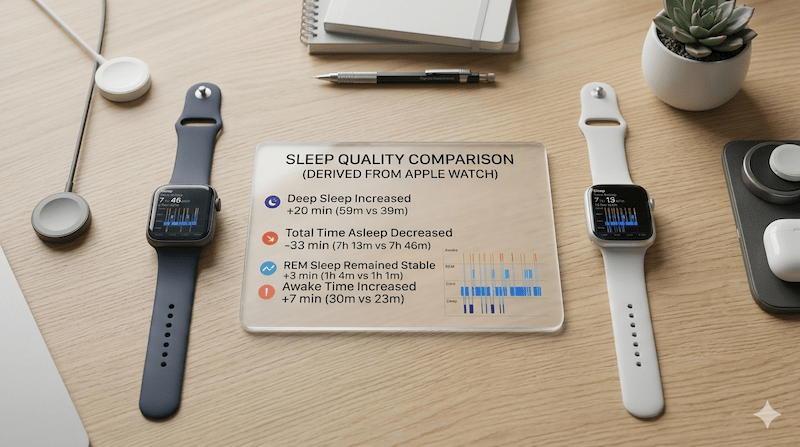
Yes, I know — the Oura Ring people will gently remind me that it’s more accurate. They’re right. But here’s my take: the Apple Watch is accurate enough to spot trends, and trends are what matter. I’m not trying to win a data science competition; I’m trying to feel better and perform better. And I can feel the difference. The numbers confirm what my body already knows. That’s enough signal for me.
One caveat worth mentioning: there’s a phenomenon called “orthosomnia” — anxiety about sleep tracker data that actually worsens sleep quality. Track to learn and course-correct, not to obsess over nightly scores. The goal is better living, not perfect metrics.
The verdict — was it worth it?
Unambiguously, yes—but let’s be realistic about the timeline. I’ve been at this for about six weeks now. At the 1.5-month mark, I’m not claiming to have discovered a fountain of youth, but the “micro-wins” are stacking up.
I have more consistent energy in the mornings. My focus doesn’t crater as hard in the mid-afternoon. Perhaps most noticeably, my mood regulation is steadier—I feel less reactive and a bit more patient with the world. There’s a budding clarity of thought I haven’t felt in a while.
While I’m only partway through this experiment, I’m reasonably confident that improved sleep quality is doing the heavy lifting for my cellular health. It’s not an overnight transformation; it’s a slow-burn investment. But for the first time in years, I feel like I’m finally trending in the right direction.
Have you made changes to your sleep habits? I’d love to hear what worked (or didn’t) — drop a comment below.
 Live Life
Leave a comment