
Lately, I’ve been noticing something—not just among those older than me, but even among people my age. A kind of quiet inertia.
It doesn’t announce itself loudly. It shows up in small ways:
- “Too troublesome.”
- “Maybe next time.”
- “Not really for me.”
And sometimes, beneath it, a hint of fear—of the unknown, of something new, of having our long-held beliefs gently challenged. I understand it. Truly. But I’ve also come to realize that if we’re not careful, inertia becomes a habit. And habits have a way of settling in very comfortably.

The Decision to Say Yes
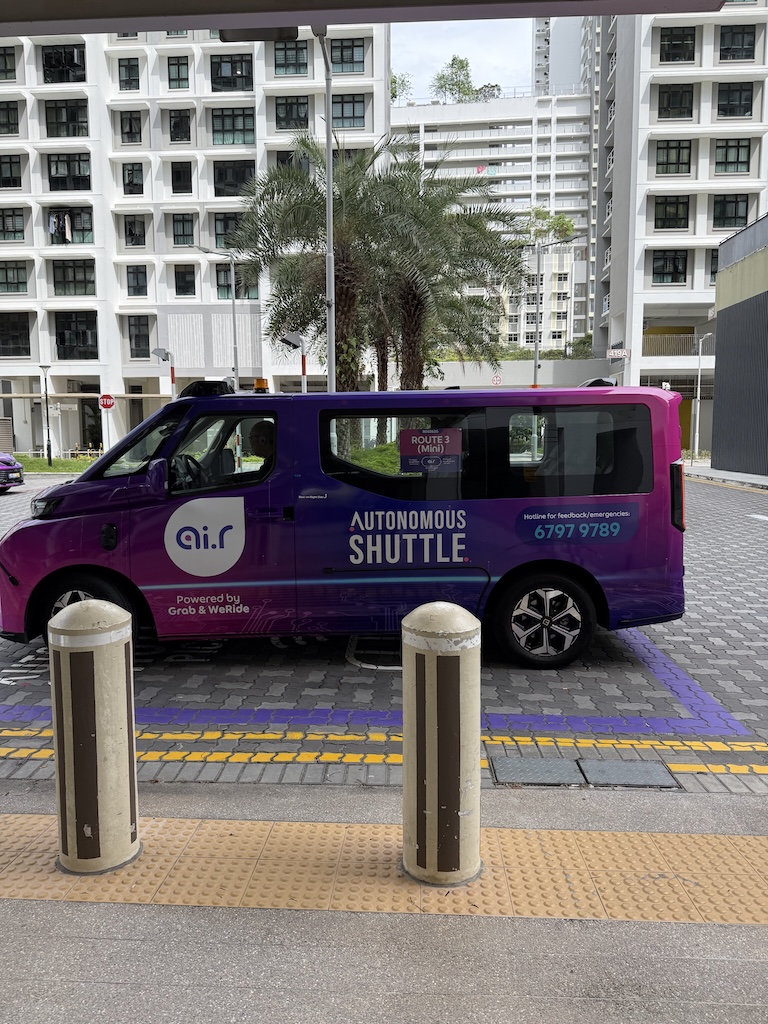
So, when I came across the opportunity for an autonomous driverless shuttle trial in Punggol, I signed up. Actually—I signed up twice. The first time, I didn’t get selected. The second time, I did.
Now, for context: I don’t live anywhere near Punggol. Making the trip meant committing to over an hour of travel for a ride that lasts…25-minutes, I saw it as a grand afternoon out—a dedicated mission to see the future in action. I was there as a curious resident, ready to see how it felt to be a ‘Future Rider’.”

The Experience: Testing the Future of Mobility
On the day itself, our group was one of many being cycled through the trial at different intervals. In my specific slot, there were three of us in the shuttle. Before we boarded, we were given a short briefing—safety precautions, what to expect, and a glimpse of how a future app might work to hail these vehicles.

And then, we were off.
There’s something quietly surreal about sitting in a vehicle with no driver. You become more aware—of the movement, the pauses, the surroundings. You notice things you might otherwise ignore. It wasn’t dramatic or fast-paced. But it was fascinating—a small window into what urban mobility might look like in a few years.
And before I knew it, the 25 minutes were up. Over an hour to get there. Twenty-five minutes on the shuttle. And completely, absolutely worth it.

More Than Just a Ride
This wasn’t entirely out of character for me. I’ve always had a quiet interest in how technology evolves—especially when it intersects with everyday life. For some time now, I’ve been following the progress of global autonomous projects like Waymo and Baidu from afar.
So, this experience in Singapore made something abstract feel real. It wasn’t something happening “somewhere else,” but something I could sit in, observe, and experience for myself.
Inertia vs. Curiosity: The Choice to Stay Open
The more I think about it, the more I feel that many of our choices come down to a quiet, ongoing tension between two forces: inertia and curiosity.
Inertia is subtle. It doesn’t push—it simply suggests:
- Stay where you are.
- Do what you already know.
- There’s no real need to try.
Curiosity, on the other hand, asks for just a little more effort:
- Go a bit further.
- Try something unfamiliar.
- Be open to not knowing.
It doesn’t guarantee anything extraordinary. But more often than not, it brings something back—a new perspective, a small delight, or even a sense of wonder. That day, curiosity won. And I’m glad it did.

Aging and the Freedom to Evolve
I’ll admit, I don’t see many women in my age group getting particularly excited about things like driverless vehicles. The conversations tend to lean more towards shopping, cooking, or travel (all of which I enjoy, too).
But this—this is something I enjoy as well. And perhaps that’s the point. We don’t have to fit neatly into what’s expected of us at any stage of life. Our interests don’t have to narrow—they can expand, evolve, and surprise even ourselves.

A Small Ride, A Bigger Reminder
In the grand scheme of things, it was just a short ride. But it reminded me of something important: Life doesn’t stop offering new experiences—we just sometimes stop accepting them.
Curiosity doesn’t disappear with age. If anything, it becomes more meaningful because we choose it more consciously. So yes, it took me over an hour to get there. And yes, I would do it again.
What About You?
What’s something you’ve been meaning to try—but haven’t? Maybe it feels inconvenient, unfamiliar, or “unnecessary.” Or maybe… it’s just curiosity waiting for a little encouragement.
Images of the trial briefing and group participants are courtesy of the Ministry of Transport, Singapore.
Leave a Reply