Brain Wealth · Singapore & Bangkok · May 2026
Longevity · Neuroscience · Brain Health

The Richest People Invest in Brain Wealth, Not Just Money
We talk endlessly about financial wealth. Diversify your portfolio. Compound interest. Passive income. But here’s the uncomfortable truth that took me until 58 to really sit with: none of that means anything if your brain isn’t around to enjoy it. A man with a fat retirement account but cognitive decline at 70 is not a wealthy man. He’s a cautionary tale in a nice apartment.
This is the blog where I talk about Brain Wealth — and this week, I want to go somewhere most wellness content hasn’t quite gone yet: the world of autophagy, zombie cells, and what they’re doing to your aging brain right now, while you’re reading this. Possibly also while you’re sleeping — or not sleeping well enough, which is a whole other section of this blog I need to confess to you about.
“Mental health gets all the headlines. But brain wealth — the biological upkeep of your actual neurons — is the conversation we should be having.”
I came across the concept of autophagy and senescent cells a few months ago, and it genuinely rearranged how I think about aging. I’m not a scientist. I’m a blogger who splits her time between Singapore and Bangkok, enjoys good food, stays curious, and has decided that 58 is an excellent age to start getting very serious about the next few decades. So let me share what I’ve learned — and what I’m actually doing about it.
S 01 — THE SCIENCE
Meet Your Zombie Cells.
They’re Not Your Friends.
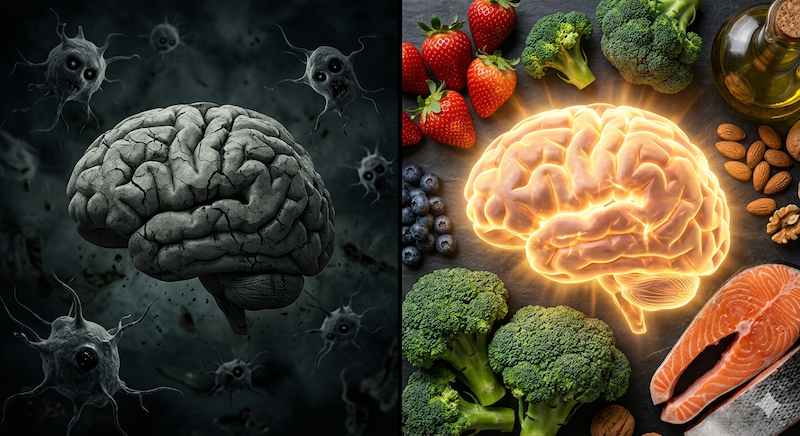
Here’s a concept that sounds like a Netflix horror series but is deeply real biology: inside your body right now, there are zombie cells. Scientifically called senescent cells, these are damaged cells that have stopped dividing and doing their job — but crucially, they refuse to die.
Think of them like that difficult colleague who stopped contributing years ago but keeps showing up to meetings, spreading negativity, and making everything around them worse. Instead of quietly retiring, they pump out a cocktail of inflammatory signals called SASP (Senescence-Associated Secretory Phenotype) — essentially a toxic cloud of inflammatory molecules that damage neighbouring healthy cells.
In a young body, your immune system clears these zombie cells efficiently. But as you age, two things happen simultaneously: more zombie cells accumulate, and your immune system gets slower at removing them. The result is a slow-burning, low-grade inflammation that scientists now call “inflammaging” — and in the brain, it’s directly linked to cognitive decline.
What They Are
Senescent Cells
Cells that have stopped dividing due to DNA damage, oxidative stress, or telomere shortening. They can’t reproduce but they won’t die — and they actively harm surrounding tissue through chronic inflammation.
What They Do
SASP: The Toxic Cloud
Senescent cells release a mix of inflammatory proteins, enzymes and growth factors that degrade tissue, impair nearby cells, and create a neuroinflammatory environment in the brain — accelerating cognitive aging.
In The Brain
Cognitive Decline Risk
In aging brains, senescent cell accumulation significantly increases — and is directly correlated with cognitive deterioration. Research confirms that clearing these cells reduces neuroinflammation and delays cognitive impairment.

S 02 — THE SOLUTION
Autophagy: Your Brain’s
Built-In Clean-Up Crew
Now for the genuinely exciting part. Your body already has a mechanism to deal with zombie cells and cellular debris — it’s called autophagy, from the Greek meaning “self-eating.” (Yes, your brain literally eats its own trash. Neuroscience is wild.)
Autophagy is a cellular housekeeping process where your cells identify, package and break down damaged components — including misfolded proteins, dysfunctional organelles, and in certain contexts, senescent cells — clearing them out so your cellular machinery can keep running cleanly. Nobel Prize-winning research (Yoshinori Ohsumi, 2016) confirmed autophagy as one of the most fundamental processes in biology.
Here’s the catch: autophagy declines as we age. Significantly. The very time when you need it most — when zombie cells are accumulating fastest — is exactly when your cellular clean-up system starts taking longer lunch breaks. More debris. Fewer cleaners. You can picture the result.
But — and this is the hopeful part of this blog — autophagy is activatable. Through diet, lifestyle, sleep, and certain supplements, you can actually nudge your body to ramp up this process. Which brings me to what I’ve been doing about it.
“Autophagy is like Marie Kondo for your brain cells — except instead of asking ‘does this spark joy,’ it asks ‘does this still function?’ If not, out it goes.”
Full Transparency // My Personal Story
I want to be real with you here. I didn’t come to this subject from a position of perfect health and smugly optimised habits. I came to it because I started noticing things I didn’t like: the occasional brain fog, waking up at 3am and not getting back to sleep, some days feeling mentally slower than I used to.
Living between Singapore and Bangkok — two cities that are extraordinary in every way but neither are exactly famous for their sleep-optimising environments — meant I’d been somewhat cavalier about sleep quality for years. These days, my wild nightlife mostly involves Netflix and telling myself I will only watch one episode. Add travel and the constant sensory buzz of city life, and my sleep quality has clearly had enough.
When I stumbled onto the research about autophagy and senescent cells, it felt personal. Not abstract. This was my brain. My neurons. My future capacity to still be sharp, curious and fully present at 68, 78, beyond. That’s the investment I’m now making. And like any investment, it requires research, commitment, and occasionally admitting when you’re still figuring things out.
S 03 — THE SLEEP PIECE
Why Deep Sleep Is Your Brain’s
Nightly Detox Programme
Here’s something that reframed sleep for me completely: your brain has its own waste-clearance system called the glymphatic system. During sleep — particularly deep, slow-wave sleep — cerebrospinal fluid flows through channels in your brain, flushing out metabolic waste including the amyloid-beta and tau proteins associated with Alzheimer’s disease.
Think of it as your brain’s nightly power-wash. Miss the deep sleep stages, and the waste accumulates. Research has even shown that a single night of sleep deprivation increases amyloid-beta accumulation in the brain. One night. That’s how important this is.
The science on exactly when glymphatic clearance peaks is still being refined — a spirited scientific debate is ongoing — but the weight of evidence is clear: deep, quality sleep is non-negotiable for brain health. It also happens to be when autophagy activity in the brain increases. Sleep is essentially a two-for-one deal on brain maintenance.
My Current Sleep Stack // Still Experimenting
Why Deep Sleep Is Your Brain’s
Nightly Detox Programme
Here’s the thing about sleep and brain wealth: they are inseparable. During deep slow-wave sleep, your brain activates the glymphatic system — essentially a nightly power-wash that flushes amyloid-beta and tau proteins directly linked to Alzheimer’s disease. This is also when autophagy peaks in the brain. Which means every night of poor sleep isn’t just tiredness — it’s missed cellular clean-up, accumulated toxic waste, and zombie cells quietly multiplying. One night of sleep deprivation has been shown to measurably increase amyloid-beta accumulation. One night.
I spent twenty years getting this completely wrong — running on what I called the “Camel Theory” of sleep, convinced I could stockpile rest and retrieve it on weekends. Science, predictably, had other ideas. I’ve written a full, honest account of how I got it wrong and what I’m now doing to fix it — the habits, the tracking, the hard changes and the ones still in progress. Read: Spent 20 Years Sleeping Wrong. At 58, I’m Finally Fixing It. →
For this blog, let’s stay focused on what bad sleep actually does to your brain biology — and why fixing it is arguably the single highest-leverage move in your entire brain wealth strategy.
S 04 — EAT YOUR BRAIN WEALTHY
The Foods I’m Eating — and
What the Science Actually Says
I’ve been deliberately incorporating three specific foods into my routine based on their research-backed connections to autophagy, senescence, and brain health. I asked for the science to be verified before including them here — because frankly, wellness content is full of hopeful noise, and I’d rather give you signal.
🍓
Strawberries
Active Compound: Fisetin · Senolytic
Strawberries are the richest dietary source of fisetin — a flavonoid that has emerged as one of nature’s most potent senolytic compounds. A 2024 study published in Aging Cell found that fisetin, taken in cycles, significantly reduced senescent cell burden in aged blood vessels, lowered inflammatory SASP markers, and restored vascular elasticity. In brain research, fisetin has been shown to cross the blood-brain barrier, reduce neuroinflammation, protect neurons from oxidative stress, and even stimulate new neuron growth. One cell study found fisetin selectively eliminated approximately 70% of senescent cells while leaving healthy cells untouched — which is a remarkable degree of precision for a compound you can put in your morning smoothie.✓ Science-backed — strong evidence
🐟
Salmon
Active Compounds: DHA + EPA · Omega-3 PUFAs
Salmon is one of the best dietary sources of long-chain omega-3 fatty acids — specifically DHA and EPA, which are the forms most directly usable by the brain. DHA is the most abundant fatty acid in the human brain and is essential for maintaining neuronal membrane integrity. Research shows EPA enhances autophagic flux by inhibiting the mTORC1 pathway — directly stimulating your brain’s cellular clean-up process. A 2025 study found that long-term omega-3 supplementation reduced accumulation of toxic proteins (amyloid-beta and tau), decreased neuroinflammation, and improved cognitive behaviours in aged subjects. The connection between salmon, autophagy, and senescence is increasingly well-supported.✓ Science-backed — strong evidence
🥦
Broccoli
Active Compound: Sulforaphane · NRF2 Activator
Broccoli contains sulforaphane — activated when the vegetable is chewed or chopped — which triggers the brain’s own antioxidant defence pathway via a protein called NRF2. This is essentially turning on your cells’ internal protective response. Sulforaphane has demonstrated neuroprotective effects in animal models across Alzheimer’s, Parkinson’s, and stroke scenarios, and human clinical trials are actively underway. Two studies in healthy older adults found improvements in mood and cognitive function. It also reduces neuroinflammation — helping contain the SASP damage from zombie cells. Pro tip from the research: raw or lightly steamed broccoli retains the most sulforaphane activity. Your over-boiled childhood memories of broccoli? Scientifically worse for you.✓ Science-backed — promising, more human trials needed.

S 05 — THE SUPPLEMENT QUESTION
What I’m Taking — and
Why I’m Being Upfront About It
Food is the foundation. But whole foods have limitations — fisetin levels in strawberries are relatively low, sulforaphane bioavailability varies enormously based on how you cook your broccoli, and omega-3 levels require significant dietary consistency to maintain. This is where targeted supplementation enters the picture for me.
I want to be completely transparent here, because I believe you deserve that from any blogger who discusses health products.
⚡ Full Transparency Disclosure
I am a Brand Ambassador for elivity. I want to be clear: I signed up because their products address specific aging issues I am personally managing, learning about, and experiencing — not the other way around. I wouldn’t put my name to something I didn’t believe in, and I wouldn’t write about it without telling you exactly where I stand.
That said — everything I share about their products represents my honest personal experience and my own research. As always, please consult your doctor before starting any supplement regimen. What works for a 58-year-old blogger in Singapore and Bangkok may not be right for your specific situation.
Two elivity Products, Two Different Jobs
I’m currently using two elivity products, and I want to be clear they serve distinct purposes. The Age Hack Protection (Fisetin + Quercetin + Lutein) is the one I’ve incorporated specifically to address senescent cell accumulation — the zombie cell science discussed above. Fisetin and quercetin are two of the most researched senolytic compounds in longevity science, and their combination appears synergistic: they work through different pathways to selectively clear zombie cells while leaving healthy cells intact. Lutein adds oxidative protection that’s particularly relevant for anyone spending time in the high-UV tropical environments of Singapore and Bangkok.
The Age Hack Rejuvenation Pack is a separate product — a broader cellular rejuvenation formula — and this is the one I’m inclined to credit, at least partially, for improvements I’ve noticed in my sleep quality and recovery. I say “partially” and I mean it: I’ve simultaneously been working on my sleep habits in the ways I described in my sleep blog, so I genuinely can’t isolate any single variable. What I can say honestly is that the combination — the lifestyle work and the supplement — seems to be moving things in the right direction.
Both products are TGA-approved, vegan, halal certified and manufactured in Australia. I’m in it for the long game, not the quick win.
I’m a firm believer that the best investments are the ones we make in our own longevity. While my focus remains on the science and my personal journey, I wanted to share a tool I’ve been using. I’ve personally seen a positive shift in my recovery and sleep quality by combining my lifestyle changes with elivity’s Age Hack routine. If you’re looking to start your own ‘Brain Wealth’ portfolio, you can use the code JANE20 at elivity.com for a discount. As always, I only suggest this because it’s genuinely part of my own daily stack.
S 06 — WHAT YOU CAN DO
Practical Brain Wealth Moves:
Start Here
Whether you’re 40, 50, or 60+, the biology is working the same way. Here’s what current research suggests you can do — most of it free — to support autophagy, reduce zombie cell accumulation, and protect your brain capital.
- 01 Prioritise deep sleep, relentlessly. This is the single highest-leverage action. Your brain’s glymphatic system and autophagy activity both depend on it. Aim for 7–9 hours, consistent timing, and protect those deep slow-wave sleep stages. Address whatever is disrupting your sleep — this week.
- 02 Try time-restricted eating (TRE) or intermittent fasting. Fasting is one of the most well-researched autophagy activators. Even a 16:8 eating window (eating within an 8-hour period) has been shown to meaningfully upregulate autophagy. You don’t need to starve yourself. Just give your cells a proper overnight window to clean house.
- 03 Eat fisetin-rich, omega-3-rich and sulforaphane-rich foods regularly. Strawberries, salmon and broccoli aren’t exotic. They’re accessible in most supermarkets. Make them weekly staples, not occasional treats.
- 04 Move your body — especially zone 2 cardio. Exercise is a powerful autophagy activator. Moderate-intensity aerobic exercise (where you can still have a conversation but it’s not easy) for 30–45 minutes has been shown to upregulate autophagy across multiple tissues, including brain cells.
- 05 Keep learning and stay socially engaged. Neuroplasticity — your brain’s ability to form new connections — requires active use. Cognitive engagement, new skills, social connection, even travel across different cultures (hello, Bangkok) all appear to support brain resilience as we age.
- 06 Consider targeted supplementation — with your doctor. If you’re interested in senolytics like fisetin and quercetin, there’s a growing evidence base to explore. Do your research, have the conversation with your healthcare provider, and approach it as one layer of a broader strategy — not a magic bullet.

S 07 — THE BOTTOM LINE
Brain Wealth Is the Portfolio That Matters Most
I’m not going to pretend I’ve cracked the code on aging. I haven’t. I’m a 58-year-old still figuring it out in real time, still working on my sleep, still adding and refining my approach week by week. What I have done is shift from passive acceptance of aging to active, informed engagement with it.
The science of autophagy, senescent cells and brain health is no longer fringe. It’s peer-reviewed, Nobel Prize-winning, actively funded and rapidly advancing. Researchers are calling senescent cell clearance one of the most promising anti-aging interventions of our time. You and I are early enough to act on it — and late enough that we probably shouldn’t wait.
Your financial wealth can be rebuilt if you lose it. Your brain? That’s a different equation. Invest accordingly.
I’ll keep reporting back — the good, the frustrating, and the still-being-figured-out. That’s the deal I made with you when I started this blog. It hasn’t changed.
“The best time to invest in brain wealth was 20 years ago. The second best time is over breakfast this morning.”
Share this with someone who needs to hear it · Tag #BrainWealth
#BrainWealth #Autophagy #ZombieCells #LongevityScience #HealthyAging #AgingWell #SingaporeWellness #BangkokLife #Fisetin #BrainHealth #Senescence #DeepSleep #Over50Wellness
Leave a Reply