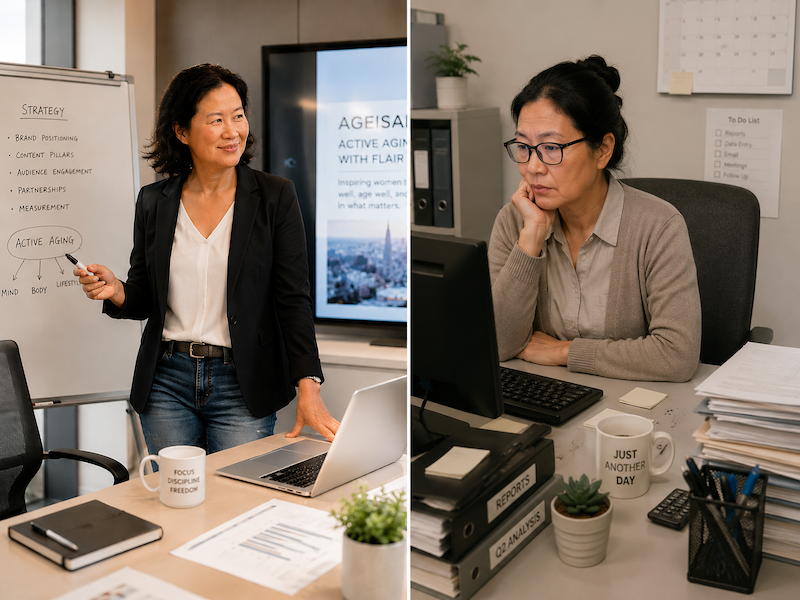
A reflection on opportunity cost, intentional living, and choosing a life you’ll never regret.

There’s a concept economists call opportunity cost. It sounds like something you’d find buried in a textbook between supply curves and GDP calculations—dry, abstract, and vaguely threatening. But strip away the jargon and it’s actually the most honest lens for looking at your life:
Every single choice you make costs you every other choice you didn’t.
That’s it. That’s the whole thing.
You can’t have it all. Not because the universe is cruel, but because time and energy are finite, and choosing one path means—by definition—not walking another. The sooner you make peace with that, the freer you become.
I know this sounds like something your wise aunt would cross-stitch on a pillow. But most people don’t actually live it. They choose, and then quietly mourn the road not taken, or worse—they refuse to choose at all, convincing themselves that with enough hustle and optimism, they can somehow have all the roads simultaneously.
Spoiler: they can’t. Neither can I. Neither can you. And I’ve been consciously, deliberately, sometimes recklessly paying my opportunity costs for most of my adult life. Let me show you what that looks like in practice.
The Taxi Fare That Started This Whole Conversation
A good friend recently told me about an incident from her marriage—years ago, her husband had flatly refused to drive her across town to save money on a purchase. Not out of laziness. His reasoning was precise: he’d rather pay the price difference, even double it, than spend the time driving there.
She found it baffling at the time. I found it completely, instantly logical. Because what he was really saying was: my time is worth more to me than the money saved. He was doing the opportunity cost math in real time, intuitively, and making a call.
Not everyone thinks this way. In fact, many of us spend years wanting everything simultaneously—the steep savings, the ultimate convenience, the great deal, and our time back. We want it all, only to find out the hard way at some juncture that we simply can’t. While some people eventually connect the dots between their chronic frustration and these competing desires, others continue to feel stuck.
That frustration has a very clear source: when we haven’t consciously decided what matters most, life has an annoying habit of making us feel shortchanged at every turn. It’s not because we’re actually losing, but because we’re measuring our current reality against an impossible standard—the version of events where no trade-off was ever required.
That version doesn’t exist. It never did. It’s not a personal failing; it’s actually quite human. We’re wired to feel losses more acutely than gains, and every trade-off feels like a loss, even when it’s a rational gain.
But here’s what I’ve learned after nearly six decades on this planet: the people who are most at peace with their lives aren’t the ones who got everything. They’re the ones who chose deliberately and then stood by their choices without constantly looking over their shoulder at what they gave up.

My Passport or My Pension? Choosing Bangkok Over My CPF
One of the biggest decisions I made was to spend much of my working life outside Singapore. Bangkok became home for many wonderful years, with shorter chapters in Shanghai and Hong Kong each adding their own colour to my story.
On paper, it probably wasn’t the smartest financial decision.
For readers outside Singapore, we have a compulsory national savings scheme called the Central Provident Fund (CPF). Both employees and employers contribute throughout a person’s working life, building savings for retirement, healthcare and housing. It provides many Singaporeans with a solid financial foundation for later life.
While many of my Singaporean friends were steadily building their CPF balances, I was building something rather different.
If you looked only at our retirement savings, I might appear to have made the poorer choice.
Fortunately, life has never been very good at fitting into a balance sheet.
Those years gave me experiences that no financial statement could ever capture. I learned to navigate different cultures, formed friendships that have stood the test of time, and discovered ways of seeing the world that I might never have encountered had I stayed in one place. Somewhere along the way, I also realised that “home” isn’t always a single destination. Sometimes, it’s a feeling you carry with you.
Would I trade those experiences for a larger CPF balance?
Not for a moment.

Saying “yes” to life abroad quietly whispered “no” to accumulating as much retirement savings. Looking back, it was a trade-off I understood, accepted and would happily make again.
What I’ve also come to appreciate is that opportunity cost isn’t something we calculate once and file away. It changes as our lives change.
As I’ve shared in recent posts, I’ve begun planning for my next chapter by securing a 2-Room Flexi BTO flat in Singapore.
In many ways, the equation has gently reversed itself.
As I grow older, saying “yes” to returning home means saying a quiet “no” to the wonderfully open-ended, cross-border lifestyle I’ve enjoyed for so many years. It’s less about giving something up and more about recognising that what I value is evolving. These days, having easy access to healthcare, familiar surroundings and the practical support that Singapore offers feels like a sensible investment in the years ahead.

That doesn’t mean this chapter is over just yet.
If anything, knowing that it has an ending makes me appreciate it even more.
The years between now and collecting the keys to my new home feel like a bonus chapter—one I intend to savour. There are still neighbourhoods to wander, favourite street food stalls to revisit, friends to meet over long conversations, and countless ordinary Bangkok moments that I know, one day, I’ll remember with enormous affection.
Every chapter eventually comes to an end.
The trick, I think, is knowing you’re in one while it’s still being written.
Different Lives. Different Riches.
Another decision was not having children.
That isn’t a statement for or against parenthood. It is simply one of life’s many possible paths.
Today, many of my friends enjoy family gatherings, adult children dropping by for dinner, and grandchildren bringing a wonderful mix of laughter, love and just the right amount of delightful chaos into their lives. Watching them, I can see the quiet satisfaction that comes from nurturing a family over decades. It is a richness all of its own.
My life has unfolded differently.

Instead of investing my time and energy in raising a family, I invested in other things that deeply fulfilled me—living abroad, travelling widely, learning continuously, pursuing creative ideas, and saying “yes” to experiences that stirred my curiosity rather than postponing them until retirement.

From time to time, I also chose to spend more on travel than some might have considered sensible. Not because luxury itself was the goal, but because slowing down in extraordinary places allowed me to experience them more deeply. Wandering through the timeless landscapes of Cuba or staying in a heritage palace in India wasn’t about indulgence; it was about immersion. Those journeys shaped me in ways that are difficult to measure.
Had I invested that money instead, my retirement savings would almost certainly look healthier today.
But then came the pandemic.

As the world unexpectedly closed its borders, I realised how grateful I was to have embraced those adventures when I had the chance. The memories, friendships and perspectives I had gathered suddenly felt far more valuable than another line on a financial statement.
Some wealth simply doesn’t appear on a bank statement.
Would I make the same choices again?
Without hesitation.
That doesn’t make my life better than someone whose greatest joy comes from children and grandchildren.
It simply makes it mine.
Perhaps that’s what opportunity cost really teaches us.
Every meaningful life is rich in something.
The only difference is what each of us chooses to invest in.

Playing Hard More Than Studying Hard
School and I had a respectful relationship.
We simply weren’t best friends.
Let’s just say my younger self invested more enthusiastically in experiences than examination results. I knew my academic strengths—and, just as importantly, my limitations.
Rather than pursuing careers where academic credentials were the main currency, I naturally gravitated towards work that valued curiosity, creativity and the ability to see possibilities where others saw obstacles.
During my years working in Bangkok, I often joked that I had somehow stumbled into a career where work rarely felt like work. Of course there were deadlines, challenges and the occasional headache, but I genuinely enjoyed what I did and the people I did it with. Looking back, that was a privilege I never took for granted.
That became something of a compass for the rest of my career. Whenever I had a choice, I found myself drawn to roles that offered room to create, experiment and connect with interesting people.

By the time I returned to Singapore, my priorities had begun to shift. I wanted to spend more time with my parents, and later, to be there as a caregiver for my father. Looking back, that season of life was another reminder that our choices evolve as we do.
My final corporate chapter came during that time, and it suited me perfectly. I was invited to create a new programme from the ground up, with the freedom to shape it in my own way. Even more rewarding was the opportunity to work closely with entrepreneurs from startups across Singapore and the wider region. I loved their optimism, their curiosity and the endless exchange of ideas.
Looking back, it was never really about returning to corporate life. It was about saying “yes” to an opportunity that aligned with who I was, while also being where I wanted—and needed—to be.
Ironically, many of the qualities that weren’t especially celebrated when I was younger—curiosity, creativity, adaptability and the ability to connect seemingly unrelated ideas—are becoming increasingly valuable in an age where artificial intelligence can process information far faster than any of us.
Sometimes the world changes before we fully appreciate the value of our own strengths.
The Life You Didn’t Choose
Here’s something I’ve come to appreciate: every person you admire has also given something up.
- The successful executive may have sacrificed family dinners.
- The devoted parent may have postponed personal dreams.
- The entrepreneur may have accepted years of uncertainty.
- The world traveller may have accumulated fewer financial assets.
- The retiree with substantial savings may have spent decades postponing adventures.
We often compare our lives with someone else’s highlights without noticing the opportunities they quietly left behind. Perhaps comparison becomes a little kinder when we remember that every choice is also a declaration of what matters most to us.

So… Can We Have It All?
I don’t think so.
Strangely enough, I find that rather comforting.
Because once we stop chasing every possible version of life, we can start appreciating the one we’ve consciously chosen.
When I was younger, I thought success meant making all the right choices.
These days, I think success is making peace with the choices we’ve made.
My life doesn’t look like everyone else’s.
It wasn’t meant to.
I have things some people wish they had.
I’ve also quietly let go of things they treasure.
And that’s true for every one of us.
Perhaps the real opportunity cost isn’t what we give up.
It’s failing to appreciate what we’ve chosen instead.
Maybe we can’t have everything.
But we can choose what matters most.
And if we’re fortunate, we can make those choices with open eyes, knowing that every “yes” quietly whispers “no”—and finding contentment in both.
For me, that’s more than enough.
Leave a Reply