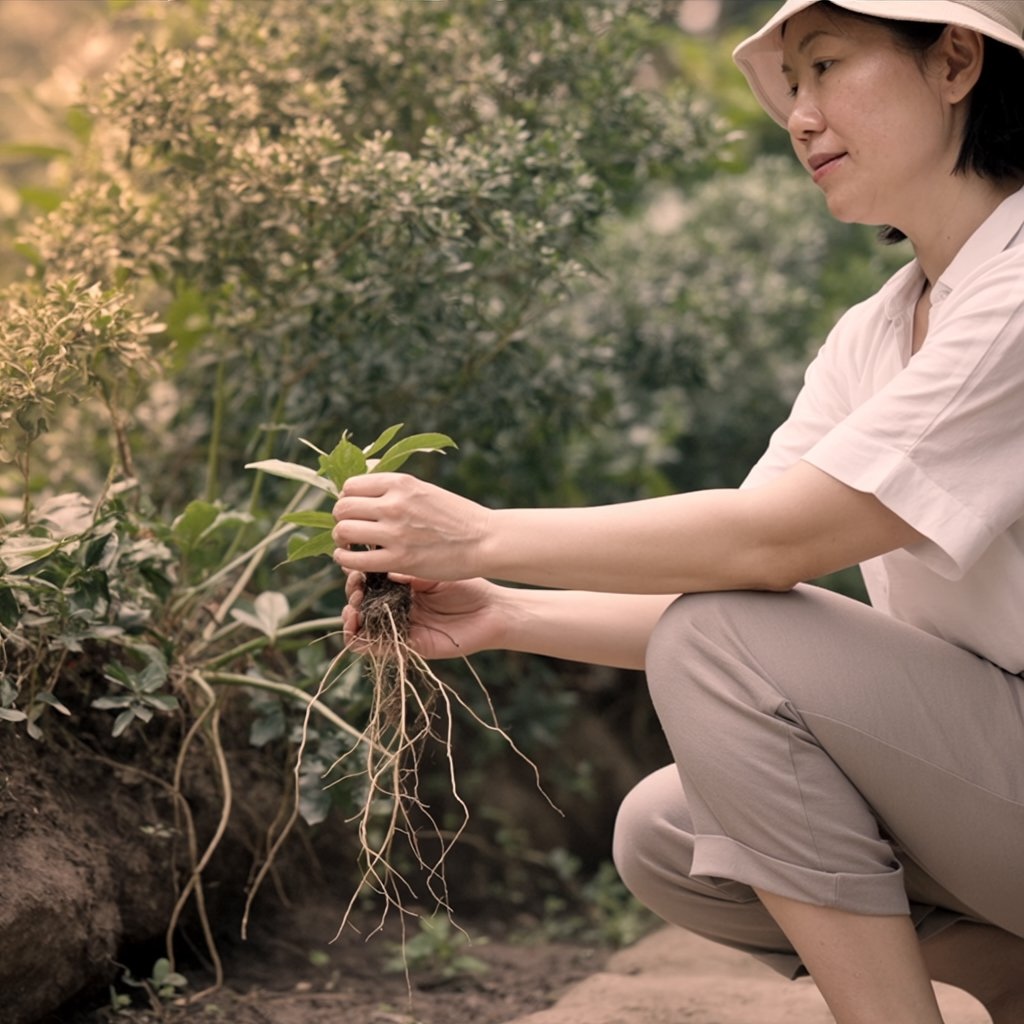
There is a Chinese saying: 斬草除根 (zhǎn cǎo chú gēn). Literally translated, it means “cut the grass and remove the roots.”

Historically, it referred to eliminating the source of future trouble. It sounds rather dramatic—perhaps something you might hear in an old kung fu movie—but the imagery has always stayed with me.
If you don’t remove the roots, the problem simply grows back.
Over the years, I’ve realised that this ancient metaphor extends far beyond its original meaning. It has quietly become one of the guiding principles in my own life.
Not just in health.
But in almost everything.

The Exhaustion of Symptom Chasing (And Why We Avoid the Root Cause)
Here’s an uncomfortable truth: most of us are professional symptom-chasers. We’re fluent in coping mechanisms and hopeless at causes. We treat the headache, not the sleep debt. We treat the falling-out with a friend, not the pattern of who we keep choosing to be close to. We treat the fatigue, not the food, the stress, the thing we haven’t confronted since 2009.
Why? Because root causes usually live in “no-go zones” — the parts of ourselves we’ve quietly agreed not to visit. Digging deeper is inconvenient, occasionally humbling, and sometimes genuinely frightening. It’s far easier to declare a problem “solved” when really we’ve just muted the alarm. And then — reliably, annoyingly — it recurs. Same problem, new costume.
I didn’t fully appreciate how deep this goes until hypnotherapy forced me to sit with the why instead of the what. That was my first lesson in root-cause living, and it’s shaped how I approach almost everything since — including, somewhat unexpectedly, my breakfast.

When TCM Meets Modern Nutrition Science: The Truth About Kale and Collagen
A few years ago I got curious about Traditional Chinese Medicine — not because I’m chasing some ancestral aesthetic, but because its underlying logic is also root-cause thinking, just wearing a different coat. TCM’s obsession with warmth, digestion, and internal balance isn’t about treating today’s bloating; it’s about treating why your body is cold and sluggish in the first place.
So now my breakfast fruit sits out for two hours before I eat it. My kale is cooked, never raw. And I’ve become the kind of person who has opinions about broth.
What surprised me was discovering that Western nutrition science and TCM, usually strangers at best and rivals at worst, actually shake hands on some of this. Cooking kale — steaming or boiling — meaningfully reduces its oxalate content, the compound that can interfere with mineral absorption and, in susceptible people, contribute to kidney stones. That’s not folklore; it’s measurable chemistry. My grandmother’s instinct to avoid raw, cold food turns out to have real nutritional backing, even if she’d have laughed at the word “oxalate.”
I’ll be honest with you, though, because you deserve honesty and not just wellness-blog vibes: the bone broth I lovingly simmer for hours? The science on it directly strengthening bones or joints is much shakier than the internet would have you believe. Multiple nutrition reviews point out that the collagen you drink gets broken down into amino acids before your body uses it — it doesn’t march straight to your femur with a name tag on. So I keep making my broth, not because I’ve got peer-reviewed proof it’s building my skeleton, but because the ritual is warm, grounding, and TCM-aligned — and sometimes that’s reason enough. Root-cause thinking also means being root-cause honest about your own claims.

Why Big Beauty is Pivoting to Root-Cause Longevity Science
Just last week, while attending a Healthy Longevity event at the National University of Singapore, I listened to two fascinating presentations that reinforced this very idea.
Professor Andrea Maier spoke about the Hallmarks of Ageing, explaining how scientists are now focusing on the biological processes that drive ageing, rather than simply treating the diseases that appear later in life.
The keynote speaker, Angeline Tay, explored skin longevity from cellular biology to evidence-based intervention. Rather than discussing beauty products, she spoke about understanding the biology of skin ageing itself.
I smiled to myself because there it was again—that same philosophy I’d encountered years ago through personal development, and more recently through nutrition and Traditional Chinese Medicine.
Different disciplines.
Different languages.
Yet the same question:
What is the root cause?

Looking Beneath the Surface Takes Courage
Finding the root cause isn’t easy.
If it were, we’d all be doing it.
It often asks us to slow down when we’d rather stay busy.
To ask uncomfortable questions.
To examine habits we’ve repeated for years.
To confront beliefs we’ve carried for decades.
And perhaps most difficult of all, to admit that the answer may not be what we expected.
There are no instant rewards.
No quick fixes.
But in my own experience, whether it’s emotional healing, nutrition, healthy ageing or simply becoming a wiser person, lasting change rarely happens on the surface.

My Takeaway
As I grow older, I’m becoming less interested in shortcuts and more interested in understanding.
Understanding my body.
Understanding my habits.
Understanding my reactions.
Understanding why certain patterns keep appearing.
Because every time I choose to look beyond the symptom and search for the root cause, I learn something that lasts far longer than any quick fix ever could.
Perhaps that’s one of the greatest lessons life continues to teach me.
Not to simply cut the grass.
But to understand the roots.
Questions for You
Have you ever solved a recurring problem by discovering its root cause rather than treating the symptom?
I’d love to hear your story in the comments.
Sometimes, the greatest wisdom comes not from finding faster answers—but from asking better questions.
Leave a Reply