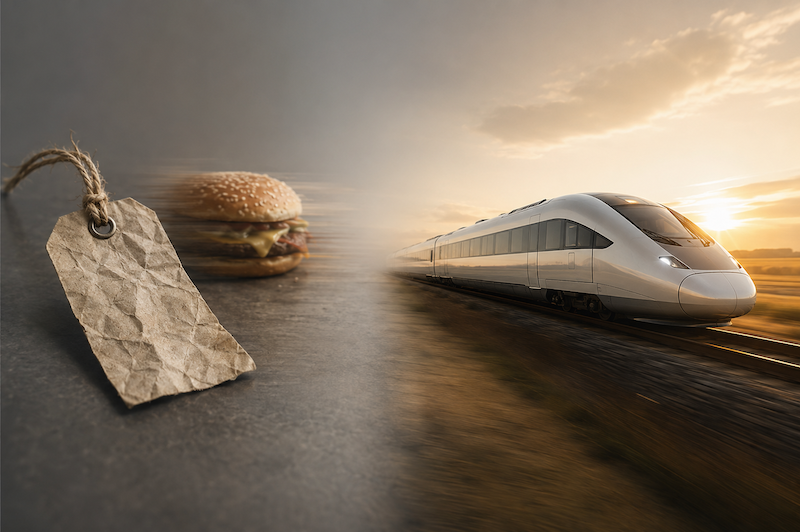

I split my life between Singapore and Bangkok, two cities that have fundamentally different relationships with the word “fast.”
Singapore will get you across the island in under forty minutes and silently judge you if you’re five minutes late. Bangkok will test your absolute sanity in gridlock traffic, only to reward your patience with the best bowl of boat noodles you’ve ever had, served five minutes from a temple that’s been standing for centuries.
Living between these two extremes has turned me into an accidental philosopher on speed. Now, everyone loves efficiency—that is a given. If there’s a high-speed rail instead of an all-stops local train, I’ll book it. In Bangkok, you will usually find me breezing past traffic on the BTS rather than sitting in a taxi. I don’t enjoy wasting time getting somewhere when I’d rather be exploring once I arrive.
But here is my actual confession: I have developed deeply conflicting thoughts about speed.
For a long time, I thought “fast” was universally good. Yet, somewhere along the way, I realised that my relationship with speed doesn’t stack up as neatly as one might imagine. While I fiercely protect efficiency in some parts of life, I’ve become deeply suspicious of it in others. Fast food, fast fashion, quick-fix health programmes, and now, artificial intelligence. There are two very distinct sides to speed, and they often feel completely at odds with each other.
That’s when it struck me: fast isn’t the problem. Knowing when to slow down is.
Here is what I’ve landed on. Fast isn’t just one thing. It’s at least three. And I only blindly trust one of them.

Fast That Helps: Cutting Friction, Not Outcomes
I am not a slow-travel purist. Give me the contactless payments, the online check-ins, and the MRT over gridlock every single time.
Why? Because this kind of speed doesn’t cut corners on the outcome—it cuts corners on the friction. The bullet train and I arrive at the exact same destination, just without three extra hours of my finite life spent staring at a bumper car in a traffic jam or sitting on an all-stops local train.
That is time I get to spend on the things that actually demand slowness: a proper meal, wandering a new neighbourhood, a deep conversation, or simply getting enough sleep. Efficient transit isn’t a shortcut on quality. It’s a shortcut on waste. It frees up our energy for the things that actually matter.

Fast That Hurts: The Shortcut Tax of Food and Fashion
Then there is the fast that costs us something—usually quietly, and usually later.
Fast food and fast fashion are cousins. Both promise you something right now (flavour, a trendy outfit, a quick dopamine hit), and both are engineered to be forgotten just as quickly.
Instead of saving us time, these shortcuts often create longer-term problems. I aged out of fast fashion’s arrival almost by accident. I had already quietly decided that clothes made to be discarded in a season weren’t clothes I wanted taking up mental or physical space in my closet.
What I didn’t expect is how much more interesting the alternative would become. When I travel now—whether I’m navigating the night markets of Luang Prabang, sourcing block prints in India, or scouring a weekend flea market in Buenos Aires for a local designer—I actively seek out independent artisans over the nearest mega-mall. Not out of pretentious purism, but because the craftsmanship is simply better. Someone’s actual skill and time went into it, rather than a factory’s speed.
Fast food, fast fashion, and quick-fix health programmes don’t charge you at the checkout. They charge you later—in your health, in landfills, and in a wardrobe full of things you never really loved. I call it the shortcut tax.

Fast That Needs a Chaperone: AI and the Calibration Problem
And then there’s Artificial Intelligence, which frustratingly refuses to sit neatly in either category.
Used well, AI is closer to the bullet train. It isn’t inherently good or bad; it is simply a powerful tool. It can draft, summarise, help organise ideas, and spark creativity, freeing up hours I can then spend on things that deserve slowness.
But there’s a version of AI use that behaves exactly like fast food.
Psychologists have been studying a concept called cognitive offloading for years, long before generative AI existed. The general scientific consensus is that when we habitually hand a mental task over to an external tool, we tend to exercise the underlying skill less ourselves.
If we outsource every decision, every piece of writing, and every problem to AI, we may gradually lose some of the very abilities we should be fiercely nurturing as we grow older. Protecting cognitive reserve and mental sharpness in our 50s and 60s is no longer a theoretical exercise—it is a deeply personal responsibility. Our brains, much like our muscles, require continuous resistance training to stay strong.
So, my rule with AI has become deliberately unglamorous: I use it to buy back time, not to buy back thinking. It drafts; I decide. It researches; I still read. It’s the intern, not the boss, and it is most definitely not the boss of my brain.
The Wisdom of Pacing
So, what is the rule of thumb for this stage of life? I ask myself one question: Is this fast option saving me time so I can spend it well, or is it quietly spending something of mine without telling me?
My initial confession still stands: I absolutely love efficiency. I will take the high-speed rail, I will tap my phone to skip a queue, and I will happily let my AI “intern” organise my messy travel notes.
But when it comes to the things that actually build a life—my wardrobe, my food, my relationships, and my own thinking brain—I absolutely refuse to pay the shortcut tax.
Because as we navigate our 50s and 60s, the goal isn’t to suddenly start moving in slow motion. It is to become ruthlessly protective of our energy, so we stop rushing through the parts of life that actually deserve our full attention.
Efficiency is a fantastic tool. But slowness? Slowness is a wealth of its own. And active aging is simply having the wisdom to know when to spend which.
Leave a Reply