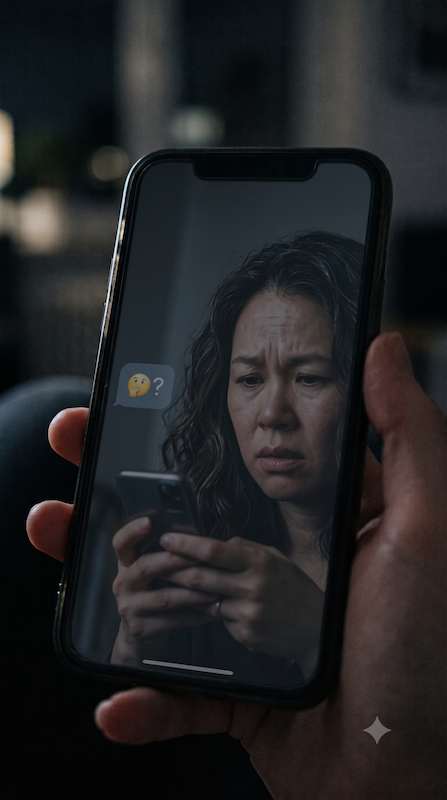

There’s a particular kind of modern chaos that happens when a perfectly reasonable text message gets read in exactly the wrong tone. You meant “sure!” as genuine enthusiasm. They read it as passive-aggressive resignation.
Even punctuation seems to have developed a personality these days. A full stop at the end of a sentence can apparently send some people into detective mode: “Why did they put a period there? Are they upset with me? What did I do wrong?” Meanwhile, the sender is probably just wondering why everyone is overthinking a perfectly ordinary message.
I’ve often found that a great deal of misunderstanding happens not because we are trying to be difficult, but because we simply default to the fastest channel available instead of the right one. We assume we’ve explained ourselves clearly. We assume silence means agreement. And more often than not, those assumptions are where the trouble begins.
Technology has never made it easier to connect, yet meaningful communication sometimes feels harder than ever. Perhaps the problem isn’t that we’re talking less. Perhaps it’s that we’re communicating less effectively.
We Are All Cut From Different Cloth
One of the wonderful things about human beings is that no two of us see the world in exactly the same way. We all arrive carrying different life experiences, different personalities, and different emotional baggage.
Here is something I remind myself often: not everyone processes information the way I do. Some people need time alone with a message before they can respond. Others need to hear your voice to catch what you actually mean. A text that feels crystal clear to you can arrive missing 80% of its context—the pause before a sentence, the warmth in your tone, the raised eyebrow that would’ve told them you were joking.
Without tone of voice, facial expressions, or body language, our minds have an unfortunate habit of filling in the blanks—and rarely with the most generous interpretation.

How Small Misunderstandings Grow
This pattern of miscommunication shows up everywhere once you start noticing it. At work, a short, efficient message meant to save everyone time reads as cold or dismissive. Within families, especially across generations, a message lands completely differently than intended.
How many friendships or family bonds have faded simply because nobody wanted to pick up the phone and clear the air?
Navigating China (and Our Differing Timelines)
Because I split my life between Bangkok and Singapore, most of my closest friendships stretch across geographies and time zones. Usually, I’m the one managing the communication from afar. When you live a hybrid life like this, you learn very quickly that you have to put extra effort into communicating, or things just quietly fall apart.
Last year, I planned a trip to China and invited a good friend from Singapore to join me. Now, I’m a planner; she’s a last-minute explorer who wants to cover as much ground as possible. To add to the complexity, our timelines were completely different—we were departing and returning on different days, taking separate flights.
If you’ve travelled to China recently, you know it operates in an entirely different digital ecosystem. From setting up Alipay and WeChat to navigating local booking apps, it requires serious logistical coordination. When I was back in Singapore, we made it a point to sit down over coffee to lay the groundwork. But the real test came after I flew back to Bangkok.
Because of the complexities of the destination and our differing timelines, our crucial follow-ups were always phone calls. Never just a text. If we’d tried to sort out the nuances of China’s payment hurdles and coordinate the logistics of our staggered flights over WhatsApp, we would have forced a compromise neither of us wanted, or quietly resented each other by day three of the trip.
Instead, over actual, real-time conversations leading up to the trip, we worked out an arrangement that honored both our styles and schedules. We figured out exactly where our paths would overlap and where they wouldn’t. Imagine trying to negotiate all of that logistical nuance over text! We’d have arrived at a decision, just not a good one.

When the Stakes Are Highest
There is another category of communication where I don’t leave anything to chance: family, particularly during times of grief and crisis.
When we were navigating my father’s last days, and subsequently planning his funeral, the stakes of under-communicating became impossible to ignore. During those heavy, emotionally exhausting days, when there were sudden medical updates or final decisions to be made about his wake, I made sure I got my brother on the phone.
It was only because we were actually speaking that I picked up on what was really going on with him. A short text message from him might have read as distant or dismissive. But hearing the exhaustion in his voice, I realized he was already under immense duress from his own work and family commitments. Because I could hear that strain, I immediately refined my own expectations. We adjusted the way we managed our schedules to visit and care for our dad so that we were supporting each other, rather than adding to the pressure.
Not a text summary. Not a forwarded voice note left for him to interpret alone in his grief. A real conversation allowed us to process the emotional weight of what was happening and ensure we were making these final, critical decisions as a team.
A misunderstood text about a parent’s end-of-life care isn’t just awkward—it can shatter a family’s peace of mind during their most vulnerable moment. When it matters this much, an extra ten minutes on a phone call is never the inconvenience. The misunderstanding would be.

Upgrading to Version 5.0: The Breakup That Wasn’t a Breakdown
But perhaps the ultimate test of choosing the right medium is when a relationship has run its course.
Now, let me be perfectly honest: I was not born with this Zen-like communication style. If you looked at the highlight reel of my past relationships in my thirties and forties, you’d find plenty of moments where I took the easy way out.
But as I navigated my fifties, I had a very deliberate desire to upgrade to a “5.0 version” of myself. I realized that if I wanted to evolve and build better connections, I had to stop repeating the communication mistakes of my past. Hiding behind a screen when things get hard doesn’t save you from the mess; it just prolongs the pain.
This conscious shift was put to the test when it came time to end my last long-distance relationship. I knew that trying to explain how my priorities had shifted via text would turn a deeply sensitive conversation into anxious guesswork.
So, I didn’t text it. We sat down face-to-face.
To be completely transparent, I did almost all of the talking, and he did the listening. I laid it all out. But we didn’t end it right then and there. I stepped back and gave him the time and space he needed to process everything I had just downloaded onto him.
When his text eventually came, it was one of total agreement. Yes, technically, we broke up over a text. But by the time that message arrived, the heavy lifting had already been done. Because I chose the courage of a real conversation first, the text wasn’t a grenade out of nowhere; it was just respectful punctuation on a discussion we’d already had in person.
Choosing the Right Tool for the Conversation
I don’t think the answer is to abandon texting—I love a good, quick-witted meme exchange as much as anyone. But I’ve learned to treat communication channels the way you’d treat tools in a toolbox:
- Texting is for logistics, quick check-ins, and formalizing a mutual decision you’ve already discussed.
- A Phone Call is for coordinating plans, anything with emotional weight, or room for misinterpretation.
- A Face-to-Face Meeting is for planting the seed on anything that could reshape a relationship.
Under-communicating isn’t a shortcut. It’s a debt you’re quietly passing on to someone else to pay, usually with interest, later.
So the next time something feels complicated enough to type out in three paragraphs—maybe that’s exactly the sign to close the app and just call. Because the goal of communication isn’t simply to be heard. It’s to be understood.
Have you ever had a text message completely misfire on you—or watched a relationship get needlessly complicated because nobody picked up the phone? I’d love to hear your story in the comments below!
Leave a Reply