
I recently balloted successfully for a BTO Flexi flat in Singapore—a major life pivot that I recently wrote about here. What I didn’t fully clock at the time was that this piece of good news came with a countdown attached. Key collection: Q1 2031.
Which means my Bangkok chapter now has something it never had before: an approximate closing date.
Somewhere between the ballot result and the paperwork, I stopped taking unlimited tomorrows for granted. Turns out, a deadline is a marvellous way to find out what you actually value.
This got me thinking about how badly most of us—myself very much included, historically—handle the idea that things end. So this week’s post is about that: the countdown clock nobody asked for, and what I’ve decided to do with it.
The Expat Countdown Clock: Why Deadlines Force Intentional Living
Here’s the maths. I currently spend about a month in Bangkok every quarter, even though my visa allows up to three. Two-plus years of doing this and I never once thought “I should use more of the runway I already have.” That’s the thing about impermanence—we don’t feel the clock until someone hands us one with a date printed on it.
So the decision: instead of spending the next three-plus years mildly resentful that Bangkok has an expiry date, I’m doubling down. Six to eight weeks at a stretch instead of four—I’m still working out how this weaves around other travel plans, so I’m giving myself a range rather than locking in a fixed number just yet. More time here, not less, precisely because it’s finite. If I only have so many quarters left with this apartment, this soi, this particular version of my life split between two cities—I’d rather max them out than ration them out of habit.

Letting Go of the Past: Why Six Years Is Too Long to Wait
Confession time, because a blog about impermanence that skips the messy bits isn’t honest. It took me six years to fully move on from my divorce. Six. Years. For someone who loves travelling, I was remarkably good at staying in one emotional place.
I’ll spare you the details, but I’ll own the pattern: A lot of us—women especially—can treat grief like a frequent flyer programme. The longer we suffer, the more emotional miles we accumulate, as though eventually someone will upgrade us to First Class for Having Loved Properly.
Sadly, there is no lounge. Nobody is checking your emotional mileage. You can have loved something completely and still be entirely done grieving it.
Once I actually crossed that line—and I mean properly crossed it, not just “posting like I’m over it” crossed it—there was no looking back. Which is the whole point of this post: the letting-go itself is the hard part. Once you’re through it, the freedom on the other side is not remotely as scary as the six years of circling made it look.

The Versions of Ourselves We Don’t Want to Let Go
And then there are the things we lose without actually losing anything tangible.
Youth, for instance. We live in a world that seems determined to convince us that looking younger is an achievement in itself. Grey hair must be covered, wrinkles softened, everything lifted, tightened and preferably returned to approximately where it was in 1997.
I have nothing against wanting to look good — I certainly do. But there is a difference between looking after the person you are today and desperately trying to retrieve the person you used to be.
Status can be just as difficult to surrender. I’ve met people who once occupied very senior positions — the head honcho, the person whose calls were returned immediately, whose diary other people organised, whose opinion could change the direction of a meeting. Then retirement arrives and suddenly nobody particularly cares what your old job title was.
That must be quite an adjustment. For years the introduction may have been, “I’m the CEO of…” or “I run…” Then one day the sentence becomes simply, “I’m…”
No title. No corner office. No assistant guarding the diary. Just you and your own dental appointments.
And perhaps that is one of life’s more interesting questions: Who are we when the title disappears?
Some people seem to make that transition effortlessly. Others continue carrying the old business card around psychologically long after it has expired. I can understand why. If you’ve spent thirty or forty years building an identity, letting it go can feel less like retirement and more like becoming invisible.
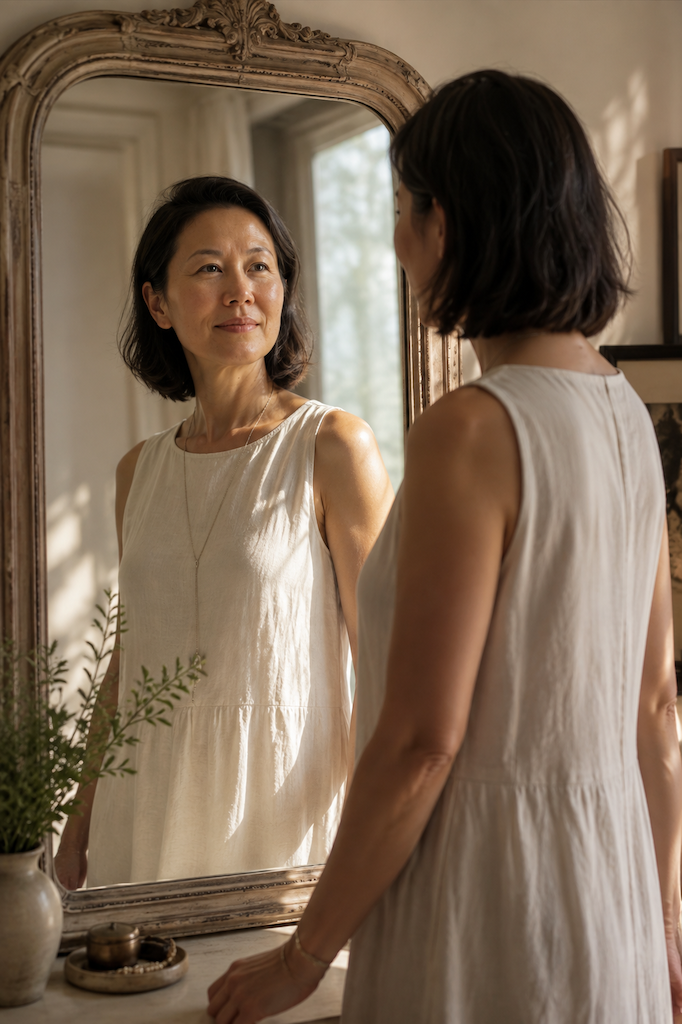
But maybe ageing asks us to do something quite different. Not to become less, but to become less dependent on the labels that once told us who we were.
The young woman was me. The wife was me. The career woman was me. The Bangkok homeowner is me.
But none of them has to be me forever. And perhaps that’s the freedom hidden inside impermanence: I don’t have to keep being who I was simply because I was once very good at being her.
The New Math of Active Aging: Spend What Is Finite
Perhaps this is the new maths I’m learning as I get older.
If something is finite, don’t automatically ration it.
Use it.
Time with people you love. The body that still takes you places. The freedom retirement gives you. The city you won’t always live in. The ridiculous dress you’ve been saving for “somewhere special.”
Somewhere special is beginning to look suspiciously like Tuesday.
That’s what my Bangkok countdown has changed for me. Yes, I’ll probably extend my stays from a month to six or eight weeks when my other travels allow. But the bigger change isn’t logistical. It’s psychological.
I’m no longer asking, “How long can I keep this?”
I’m asking, “How well can I use it while it’s mine?”
Perhaps that’s one version of active ageing we don’t talk about enough. We spend plenty of time discussing how to extend life. I’m becoming equally interested in how not to postpone it.

One Door, Two Keys: Finding Peace in Life’s Next Chapter
Buddhist thought has a word for the impermanence of all things: anicca. I’m no scholar, and I’m certainly not about to turn this into Buddhism 101, but the idea resonates with me—the more desperately we insist that something must remain as it is, the harder change becomes when it inevitably arrives.
The BTO key I’m waiting for and the Bangkok key I’ll eventually hand over aren’t opposing forces. They’re simply two chapters of the same life.
One will arrive. One will eventually leave my hand.
But here’s what I’m finally beginning to understand about impermanence: knowing something will end doesn’t make what comes before it less valuable. It makes it more valuable.
I could start mourning Bangkok now. I could count down the remaining years, become sentimental about every familiar soi and imagine how much I’ll miss this place when it is no longer mine.
Or I could stay longer.
Drink my coffee on that balcony. Walk the neighbourhood. Eat the food. See my friends. Travel. Come home. Leave again. Come back.
Live it instead of rehearsing losing it.
I spent six years once learning how to let go of something that had already ended.
I’m not going to spend the next few years grieving something that is still very much here.
One day I’ll hand over one set of keys and collect another.
Until then, Bangkok and I still have some living to do.
Leave a Reply