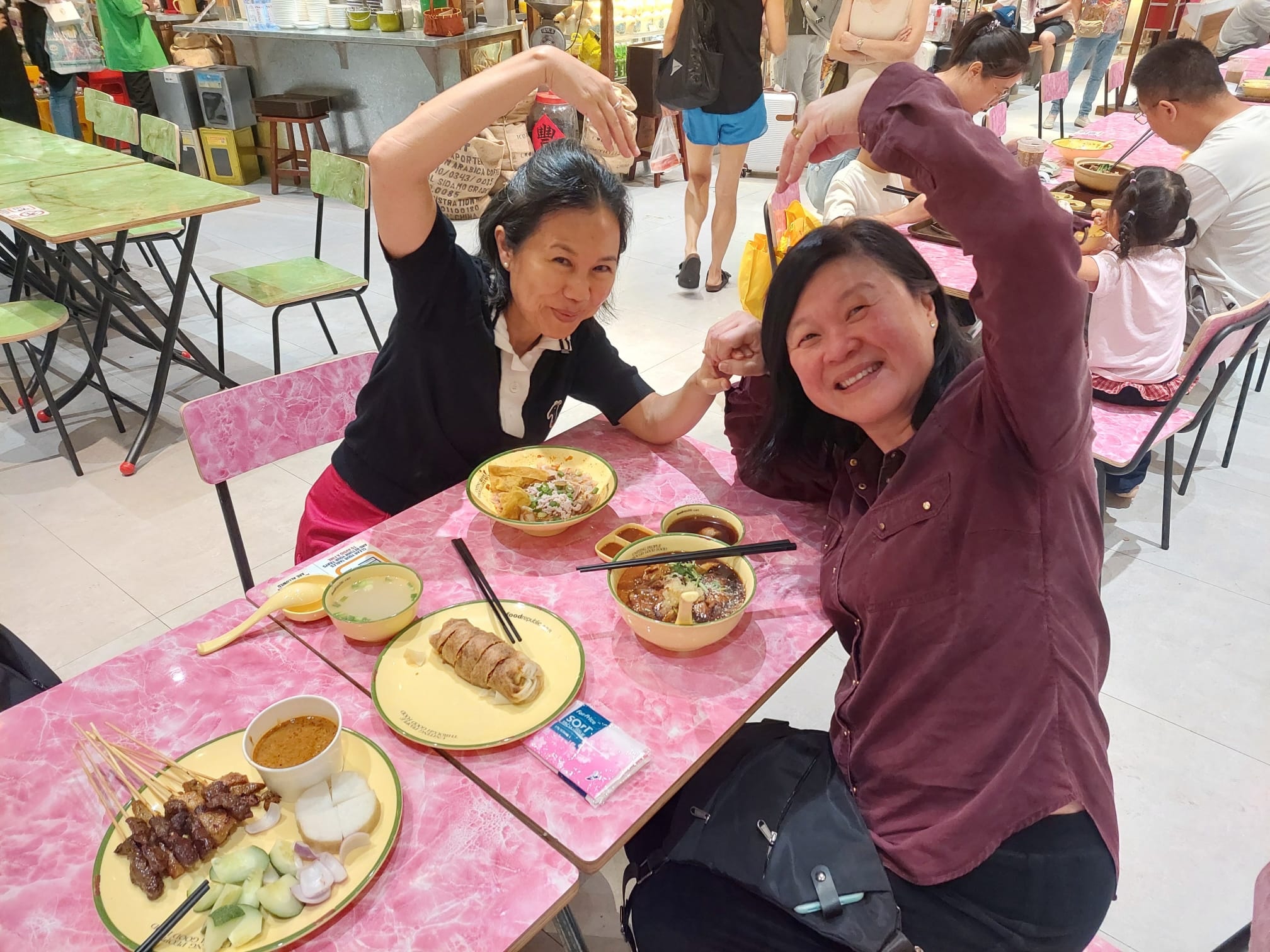
From cross-border airport catch-ups to sourdough deliveries. Discover why redefining community and letting go of draining relationships is key to active aging.

One of the ideas that comes up often in conversations about longevity, including the Blue Zones, is the importance of community.
I have been thinking about what that word actually means to me.
My definition is fairly simple: community is having people, near or far, whom you can reconnect with easily—people who really get you without requiring too much explanation.
The sort of people with whom you don’t have to provide the backstory, footnotes and PowerPoint presentation before you can get to the point.
And increasingly, I realise that my community doesn’t look quite like the one I might have imagined when I was younger.
Who Says Our Lifelong Friends Have to Come From School?
There is a romantic idea that our closest lifelong friends are the ones who knew us at school or university.
That hasn’t entirely been my experience.
I do have one bestie from my school days. We have gone on to live very different lives—she now lives in Adelaide, while my own path has taken me elsewhere—but somehow the friendship has evolved along with us. If anything, age has made us more real with each other, not less.
Recently, she was transiting through Singapore on her way to London. There wasn’t much time, but we found the window and caught up.
Perhaps that is why the friendship has endured. We haven’t needed each other to remain the people we were when we first met.
But she is very much the exception rather than the rule in my own friendship story.
I became fairly mobile from my 30s onwards, and many of my closest friends were equally mobile. Interestingly, I don’t have that many close friends remaining in Singapore; many have migrated or built lives elsewhere.
Some of the friendships that became most important to me didn’t begin until my 30s and 40s.
One particularly dear friendship began in perhaps the most practical way possible: she was—and still is—my landlady in Singapore.
I met her in my 40s, and somewhere along the way, the relationship quietly shifted from landlady and tenant to genuine friendship. More than a decade later, she remains not only my landlady but a dear friend whose generosity has shown itself in countless ways.
Most recently, while I was in Bangkok, she went to officially sign off on my BTO flat on my behalf, saving me from having to jump on a flight back to Singapore at short notice.
Sometimes the people who become important to us enter our lives wearing the most unexpected labels.

All of which makes me wonder whether we place too much emphasis on when we meet our closest friends, rather than what those relationships become.
History is lovely. Shared history can be precious.
But perhaps what matters more is whether there is room within that history for both people to keep changing.
When History Is No Longer Enough
This past year, I walked away from two very close relationships.
One began in Singapore in my 20s. The other started in Bangkok in my 30s, with someone I subsequently travelled extensively with.
There was a lot of history in both relationships, which made letting go particularly difficult.
But somewhere deep down, I think I had known for some time that these friendships had become more draining than restorative.
That is not the same as saying friendships should always be easy.
Of course they aren’t.
People go through difficult periods. We disappoint one another. We have bad days and occasionally bad years. A good friendship isn’t one in which everybody turns up permanently cheerful and bearing homemade kombucha.
What I am learning to recognise is the difference between circumstance and pattern.
Is my friend going through something difficult?
Are we simply having a rough patch?
Or do I repeatedly leave our interactions feeling depleted?
And sometimes there isn’t a villain in the story at all.
Perhaps two people who once travelled very happily along the same road have simply reached a junction and discovered they are heading in different directions.
Our values can evolve. Our priorities can shift. The way we want to live the next part of our lives may no longer be quite so aligned.
That can be sad without making either person wrong.
Friendship Doesn’t Always Need Proximity
At the same time, some of my closest friendships have shown me that physical distance doesn’t necessarily create emotional distance.
Recently, one close friend was passing through Singapore on her way from Australia to London. Her window was small, so we met at the airport.
Another close friend was in Singapore on an express business trip. We caught up in her hotel executive lounge before she had to return to San Francisco.
These weren’t chance encounters with new acquaintances.
These were friendships important enough that when geography briefly put us in the same place, we found the window.
I love that.
Perhaps that is one of my measures of community now. We don’t need constant access to one another. We don’t necessarily need to live in the same city—or even the same country.
But when the opportunity presents itself, we make an effort to show up.
My friendships seem particularly adept at doing this in Bangkok.

On a recent trip, I managed to see a friend before she returned to Yangon for work. I also caught up with a friend from Shanghai whom I’ve known for close to 30 years, and his wife, with whom I now keep in touch more regularly. Over the years, as all of us relocated, our paths have crossed every now and then in different cities—from Hong Kong to Bangkok. This time, knowing they would be in Bangkok to celebrate his birthday gave us another chance to meet. Some friendships don’t need constant contact; serendipity simply keeps putting us back in the same place.

And then there is a friend who actually lives in Singapore, yet somehow we seem more successful at meeting in Bangkok.
Apparently our calendars require international travel before they will cooperate.
Maybe Birds of a Feather Don’t Have to Look Alike
Looking around this rather geographically untidy community of mine, something else strikes me.
On paper, we aren’t necessarily obvious birds of a feather.

There are people from corporate life and people who have left it. A homemaker. Someone working in the NGO world. People whose lives stretch from Shanghai to Silicon Valley and various points in between.
Different backgrounds. Different careers. Different choices.
And no, I don’t think community requires a passport, an airport lounge or a collection of boarding passes.
Those are simply the circumstances of my particular life.
What interests me is what these very different people seem to have in common.
They are comfortable in their own skin.
They don’t seem to have much need to prove themselves.
And I increasingly value that enormously.
There is an ease about being with people who aren’t performing a version of themselves for the room.
Nobody needs to establish their credentials before sitting down for coffee. Nobody needs to win. Different opinions don’t automatically become competitions.
We can be curious about one another’s lives precisely because they aren’t all the same.
Perhaps birds of a feather don’t have to look alike after all.
Maybe the feather is simply being comfortable in your own skin.

Friendship That Arrives as Sourdough
And then there are the quieter expressions of friendship.
I have a dear friend who, bless his heart, is passionate about baking sourdough bread. This is largely responsible for my having enjoyed a remarkably dependable supply over the years—delivered, no less.
And it doesn’t stop at bread.
There has been homemade kimchi, passion-fruit kombucha and various other healthy experiments appearing in my life.
Obviously, I am not suggesting that admission to my inner circle requires fermented goods.
Although standards are standards.
What stays with me isn’t really the bread or the kombucha.
It is the thought behind them.
Someone made something, thought of you and included you in their life.
In the same way, generosity isn’t only about things. I think about my landlady and the many ways she has shown generosity over the years. I think about friends who make room in absurdly compressed travel schedules. I think about the people with whom months can pass, yet conversation resumes without ceremony.
Community can sound like a grand concept.
Very often, it shows itself in wonderfully ordinary ways.
A loaf of bread.
A message.
Forty-five minutes at an airport.
A coffee squeezed between meetings.
Someone remembering.
Someone showing up.

Perhaps Our Criteria for Friendship Change
When we’re younger, friendships often form around circumstances.
School. Work. Neighbourhoods. Hobbies. Being at the same stage of life.
Those circumstances can create wonderful and lasting friendships.
But as I think about my own next chapter, I find myself less concerned about whether someone and I have similar lives.
I’m more interested in how we are when we’re together.
Can we be curious about each other’s different worlds?
Can we disagree without needing to convince?
Can we celebrate each other’s happiness without comparison?
Can we be honest without being unkind?
Can we sit together without performing?
And perhaps most importantly:
Can I be myself around you—and can you be yourself around me?
That doesn’t mean I need every friendship to be effortless or endlessly positive.
Quite the opposite.
The people closest to us will sometimes challenge us. They will have difficult seasons. So will we.
But there is a difference between a relationship occasionally requiring energy and one that consistently takes more from us than it restores.
I think I recognise that difference more clearly now than I did when I was younger.
The People I Want Around Me in My Next Chapter
If community contributes something meaningful to a long and good life, perhaps the answer isn’t simply to collect more people around us.
For me, it is becoming more about recognising the relationships that are reciprocal, genuine and restorative.
Some have been with us for decades.
Some arrived much later than we expected.
Some live thousands of kilometres away.
Some started out as our landlady.
Some appear with sourdough.
And some relationships that once mattered enormously may eventually have completed their part in our story.
Perhaps part of growing older is accepting all of those things at once.
It is appreciating history without believing that history alone obliges us to continue a relationship.
It is recognising the people who still make the effort to find that small window when your lives intersect.
And it is remaining open to people whose backgrounds, careers and lives may look nothing like our own.
Because I no longer think our community is a guest list we complete early in life and spend the following decades maintaining.
It can keep evolving as we do.
There are people in my life today whom I couldn’t have imagined knowing 20 or 30 years ago.
And there may well be people who will become important to me whom I haven’t met yet.
I rather like that thought.
So perhaps the people I want around me in my next chapter aren’t defined by where they live, what they do or how long I’ve known them.
They are simply people who are comfortable enough in their own skin to allow me to be comfortable in mine.

They are simply people who are comfortable enough in their own skin to allow me to be comfortable in mine.
At this stage of life, I’m no longer interested in maintaining connections out of sheer obligation. I want to share the chapters ahead with people who make the journey feel a little lighter, a little warmer, and entirely real.
Leave a Reply