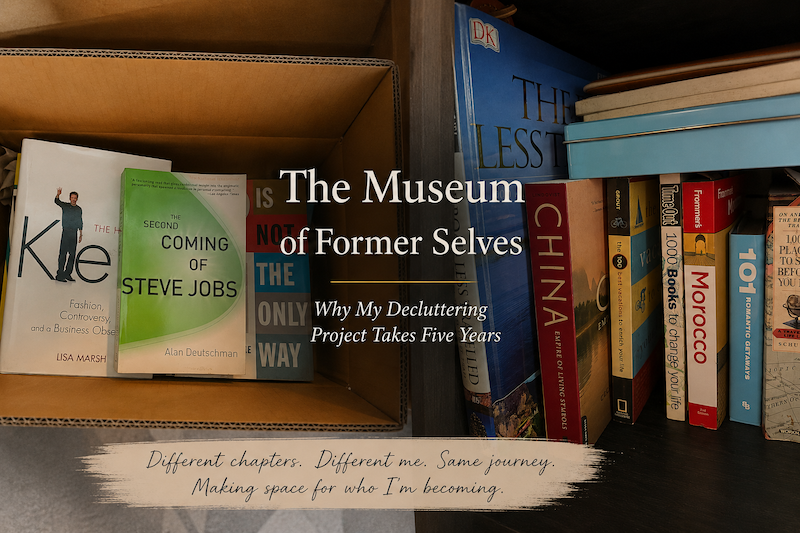
Why decluttering in midlife isn’t about tidiness — it’s about identity, release, and the surprising longevity returns of letting go.

There is a particular kind of archaeology that happens when you decide to declare your independence from clutter in midlife. You don’t just find things. You find former versions of yourself — preserved in hardcover, wrapped in bubble wrap, and sealed in a kitchen cupboard you haven’t opened in three years.
That was me last week, elbow-deep in a Bangkok kitchen cupboard, unearthing a set of fancy Thai cooking dishware. Still wrapped. Still waiting for a dinner party version of me that, apparently, never showed up. I laughed — then I packed it up to give away.
This is year two-plus of my five-year slow decluttering method: a deliberate, unhurried clearing of things that no longer represent who I am.
- Books I bought with great intention and barely opened.
- Music CDs from an era when my career was flying, money came easy, and I shopped the way some people breathe — reflexively.
- Dishware for a lifestyle I never quite lived.

Identity Archaeology: The Fossil Record of Past Selves
Here’s what nobody tells you about decluttering after 50: it’s not really about the stuff. It’s about identity archaeology.
Granted, some are meticulous enough to have read every book they’ve ever bought. But for the rest of us, our closets and shelves tell a different story. If it isn’t an unread book, it’s a beautifully tailored dress hanging in the back of the wardrobe, tags still attached, waiting for an event or a social version of ourselves that never quite materialized.
Each unread book, unworn outfit, or unused gadget is a data point — a record of who you thought you’d become, what you were curious about, and what version of your future self seemed plausible at the time. The cookbook for a chef you never became. The evening gown for a lifestyle you outgrew or never leaned into. The philosophy tomes for a contemplative “you” that never quite settled in.
None of that is a failure. It’s simply change. The problem arises when we treat our possessions as proof of who we are, rather than artifacts of who we were. Holding onto them doesn’t preserve those selves; it just clutters the space that the current you needs to breathe.
“Letting go of things isn’t loss. It’s a belated permission slip — finally telling a past version of yourself: it’s okay, you don’t have to be that person anymore.”
The Longevity Mindset: How Cleared Space Compounds
Here’s where intentional living meets practical reality — and where I’ll admit to a small, dry financial regret. Those books, CDs, and dishware were purchased 15 to 20 years ago, when money moved easily. I sometimes think: if I’d invested even half of what I spent on things I barely used, compound interest would have done extraordinary things with it by now.
But here is the longevity mindset reframe I find much more useful: space compounds too.
The physical, mental, and emotional space you clear today doesn’t just feel lighter now — it pays dividends forward:
- Reduced Cognitive Load: Every shelf you empty is cognitive overhead you no longer carry.
- Decisive Action: Every box you send away is a decision you no longer have to defer.
- Lower Stress Hormones: Research in environmental psychology consistently shows that cluttered spaces elevate cortisol levels and fragment attention.
In terms of healthy aging and longevity, that’s not trivial. Chronic low-grade stress is one of the quietest enemies of aging well. Clearing out isn’t just tidying; it’s a long-term investment in the quality of your attention, your energy, and your mental health.

Why a “Slow Declutter” Works Best for Midlife
I’ve given myself five years to complete this process. I’m currently two-and-a-half years in. People often raise an eyebrow at this — why not just do it all in a weekend, KonMari style?
I get the appeal of the quick fix. But a rapid purge assumes a kind of emotional readiness that doesn’t always arrive on schedule. For an intentional living practice, a phased approach is essential for a few key reasons:
- Building the “Letting Go” Muscle: The willingness to release things deepens gradually. Early on, I held onto things I’ve since let go of with complete ease.
- Lifestyle Flexibility: Splitting my time between locations means I am rarely in a rushed frame of mind, allowing decisions to settle naturally.
- Emotional Processing: Even something as small as tearing up poorly taken photographs — which I’ve started doing — would have felt oddly drastic two years ago. Now, it feels clarifying.
The momentum builds. The identity of “someone who keeps things” quietly gives way to the identity of “someone who travels light.”
“Less is more isn’t a destination. It’s a practice — one that gets easier and more rewarding the longer you stay with it.”
A Simple Filter for Intentional Living
The filter I now use for decluttering sentimental items is simple but surprisingly effective:
“Does this object belong to who I am today, or to who I thought I’d be?”
Things that pass through that question honestly tend to be few. And the ones that stay feel genuinely chosen, not just kept by default.
We attach meaning to objects the way we attach meaning to people, places, and chapters of life. I’ve come to think of sentimentality as a form of love that occasionally needs to be updated. You can love a version of your past without needing to store it indefinitely in a plastic tub. The things you give away don’t disappear from your story; they just stop taking up room in your present.
I’ve still got 2.5 years to go. But the direction is clear, the pace feels right, and the mantra holds: Less is More — not as a minimalist design aesthetic, but as a way of moving through the world with less weight and more intention.
And somewhere out there, someone is going to love that Thai dishware.
Leave a Reply