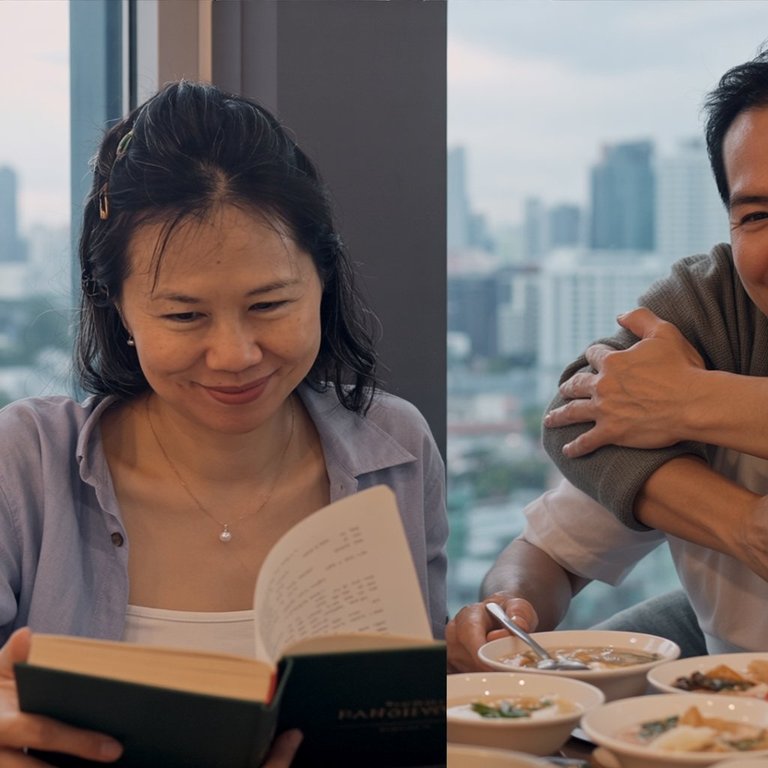

There seems to be a universal belief that happiness always lives somewhere else.
If we’re single, we imagine life would be better with a partner. If we’re married, we occasionally fantasize about the absolute freedom of answering only to ourselves. If we’re happily single, society often projectively assumes we’re secretly lonely and looking for someone to “complete” us.
Human beings are remarkably good at believing that the grass is greener on the other side.
There is a legendary Solvil et Titus watch advertisement that has made grown adults across Asia quietly reach for tissues for decades. Its famous tagline says, simply: “Time is fleeting; it is better to have loved and lost than to never have loved at all.” A whole philosophy packed into a timepiece commercial. Only in Asia could a watch make you question your entire romantic trajectory.
I think about that campaign often. Having been married, single, attached, and single again, I can report with the absolute authority of someone who has genuinely lived it: the grass isn’t necessarily greener anywhere. It is simply different grass.
And every single patch requires maintenance.
The Wife Years: Love, Sunday Lunches, and Built-In Tech Support
I’ve had a front-row seat to both versions of reality. First came the comfort and companionship that come with sharing a life with someone. There is something profoundly reassuring about having a partner who knows your history, understands your quirks, and has witnessed both your triumphs and your less-than-glorious moments.
But in an Asian context, marriage doesn’t just change your relationship status; it completely reorganizes your life.
For years, every Sunday, without fail, I was at my mother-in-law’s home for lunch. It was non-negotiable. It was ritual. It was a structured, intergenerational love that came with traditional soup and family obligations in equal measure. My social life naturally revolved around couple friends—lovely people seen mostly in pairs, at dinner tables designed for even numbers, where conversations gravitated toward mortgages and school choices.
Living with another human being requires deep compromise and patience. But there were undeniable perks. Practically speaking, there was always an “engineer” in the house. When something broke, it got fixed quietly, without me needing to watch a YouTube tutorial at midnight.

The Single Years: Freedom, a Toolkit, and Solo Adventures in Bangkok
When that chapter closed, I had to become the engineer. Leaky tap? My problem. Wi-Fi router blinking an ominous red? Also my problem. There is a specific kind of competence that single life forces upon you, and honestly, it is quietly empowering once you stop being annoyed by it.
With that independence, my world expanded completely. I now split my time between Singapore and Bangkok, building a life that is genuinely mine—curious, mobile, and delightfully unconventional. My friends come from every phase and corner of the globe. My social life is no longer constrained by couple symmetry. I have dinner with whoever I find interesting, whenever I feel like it, on a whim, because I can.
The freedom is real. Nobody leaves wet towels on my floor anymore (unless I am the culprit).
But what surprised me most was discovering that solitude and loneliness are not the same thing. One is a circumstance; the other is a feeling. You can be married and lonely. You can be single and perfectly content.
The Rise of the Accomplished Single Woman
In my circle—particularly among smart, successful women in Singapore and across major global hubs—I’ve noticed a quiet retreat from love happening in real-time.
These are not women who have “failed” at relationships. Quite the opposite. They are accomplished, independent, financially secure, well-travelled, interesting, and fully capable of creating meaningful lives on their own terms.
Some have simply concluded that modern romantic relationships are more trouble than they are worth. After disappointments, heartbreaks, or acute dating fatigue, they have decided they are done. Not bitter. Not angry. Just done.
When women become professionally and financially equal, marriage shifts from a socioeconomic default to an intentional choice. When it’s a choice, the bar naturally rises. And when candidates don’t clear that bar, many accomplished women simply stop holding it up altogether.
I understand this entirely. Yet, underneath the fierce independence, I sometimes glimpse a quiet, protective armor. The decision to stop believing in love is occasionally disguised as a lifestyle preference, when it is actually an act of self-preservation.
What Longevity Science Says (And It’s Hilarious for Women)
Because my readers know I love a good healthspan deep dive, I looked into what the data says about relationship status and aging. The scientific reality genuinely made me laugh.
Research has long shown that marriage benefits men’s health and longevity significantly. Studies consistently indicate that married men are healthier and live substantially longer than unmarried or divorced men.
For women? The picture is far more nuanced—and entirely in our favor. The long-running Terman Life-Cycle Study found that while steadily married men lived the longest among males, divorced women lived almost as long as their married peers. Furthermore, women who stayed single, chose divorce, or were widowed often lived remarkably long, vibrant lives.
A European study even pointed out that mortality rates were twice as high in unmarried men compared to married men, while the disparity between unmarried and married women was incredibly modest.
The translation? Men, it seems, need us to live long. We, it seems, manage perfectly well either way. So ladies, if your single girlfriends tell you they are choosing singlehood for their longevity—the science suggests they aren’t entirely wrong!
The Wedding Table That Could Have Been Awkward (But Wasn’t)

Last year, I attended the wedding of a mutual friend’s daughter. As fate would have it, my ex-husband and his current wife were also there. Not only were we at the same wedding—we were seated at the exact same table. All evening.
Oh, and did I mention this was nearly 20 years after our divorce?
In Asian social circles generally, this kind of setup is treated as a potential catastrophe—a situation to be managed, avoided, or at least extensively whispered about. It sounds like the opening scene of a dramatic disaster movie.
Instead, it was completely uneventful. We chatted, enjoyed the celebration, and shared the table gracefully. Nobody needed rescuing, nobody hid behind the floral arrangements, and the world continued spinning exactly as it should.
When relationships end, people assume the finale must be permanently accompanied by bitterness or hostility. But nearly two decades later, you realize that life is simply too short to carry old baggage. Sometimes, two adults simply move on and build entirely separate, beautiful lives. I left that wedding feeling incredibly grateful—not for the past, but because everyone was entirely comfortable in the present. That felt like a quiet victory for human maturity.

Why I Haven’t Handed in My Romantic Membership Card
While I thoroughly understand the women who have closed the door to love, I haven’t quite reached that point.
That doesn’t mean I spend my days searching for Prince Charming or performing contentment while secretly despairing in Bangkok cafés. Far from it. I genuinely love my freedom, my independence, and my complete ownership of my time. If love never arrives again, my life will remain rich, full, and deeply satisfying.
But I still choose to believe in love.
Not because I need someone to complete me, and certainly not because I think a relationship is a magic wand to solve life’s problems. I believe in love because I have experienced it. Not every love story lasts forever, but that doesn’t mean it wasn’t real, beautiful, or worthwhile for the season it lasted.
Remaining open to love feels less like an active search and more like an internal attitude. It’s an openness to possibility, a willingness to be surprised, and a stubborn refusal to become cynical. I am a happily single but I haven’t handed in my membership card to the romantics’ club just yet.
Tend Your Own Grass
Society treats relationship status like a scoreboard. Married? Congratulations, you won a trophy. Single? Better luck next time. Thankfully, life is rarely that simplistic. A bad partnership is infinitely worse than being single, and a spectacular partnership is a beautiful addition to life. The variable that matters is the quality of the connection, not the category it fits into on a legal form. Being single does not automatically make someone more liberated, just as being married does not automatically make them more stable.
The secret isn’t finding greener grass on the other side of the fence. The secret is learning to appreciate and nurture the exact patch you are standing on right now.
Some seasons call for partnership. Some call for fierce independence. The trick is not to spend so much time looking longingly over the neighbor’s fence that we forget to water our own garden.
As for me, my grass is growing quite nicely. 🌱
Leave a Reply